Beaded Crochet Hats: Mark the Hanging Drop
For a beaded crochet hat, ask the manufacturer to define the hanging-drop attribute with named start and end points, an identified sample condition and the unit used for its reported value. Keep that definition with the offered product and quotation version. A catalogue photograph shows decorative terminals, but it cannot supply a reliable drop measurement or establish which garment edge the manufacturer uses as the reference.
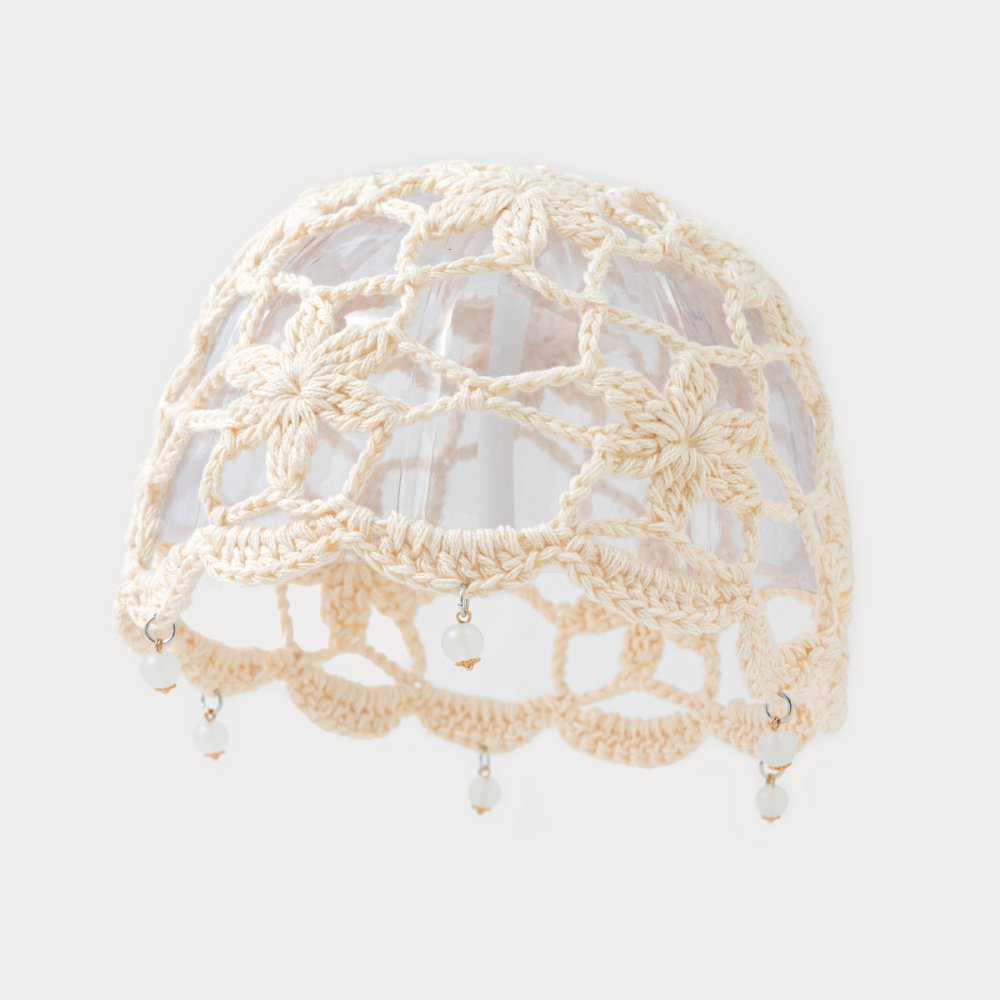
Official Crocheted Hat 20 reference. The clear display stand is not a supplied part. Hanging bead lengths, bead material, attachment properties and delivered arrangement require manufacturer confirmation.
Identify the actual Crocheted Hat 20 reference
Yuehong’s catalogue names Crocheted Hat 20 and describes it as handmade with hanging beads. The image shows a pale openwork hat with light-coloured decorative terminals hanging below parts of the lower outline. Use the exact product reference when asking for the hanging-drop definition. The manufacturer should identify the version and sample to which its reply applies.
The page includes a size entry of 56–58 cm. That entry does not identify the length of a hanging decoration or define the start and end points for such a measurement. Keep the proposed hanging-drop attribute separate from the catalogue size label. Ask the supplier to name the relevant attribute rather than assigning an existing number to a different part of the product.
Ask the manufacturer to name the start point
A lower garment outline can include several visible curves or projecting sections. Ask the manufacturer which named location it uses when describing a hanging drop. An available annotated reference can show whether its stated attribute begins at an identified garment-body edge, a decoration connection reference or another point it defines. Retain the supplier’s explanation with the proposed value.
Do not select a point from the photograph and present it as an agreed specification. The displayed hat shape and the angle of the view can make a visible area easy to recognise without establishing a measurement convention. Ask the manufacturer to make its own reference clear enough to distinguish the location it means. If the start point remains unclear, keep that question open in the enquiry.
Official Straw Hat 2 appearance reference. Displayed hats do not define supplied shape, packing arrangement, offered colour mix or verified decoration material.
Define the terminal point and the attribute scope
Ask the manufacturer to identify the corresponding end point and to state what its hanging-drop attribute includes. A reference ending at a terminal bead is different from an attribute ending at another named decoration boundary. The supplier should explain the point used for its actual reported value. Keep the named end point and the start-point description together.
Also ask whether the manufacturer uses one reference for the offered decorative arrangement or separate references for particular locations. The photograph does not establish identical drops, a complete supplied bead count or an arrangement shared by every offered version. Request the actual scope of the supplier’s reply. The buying record should identify the reference being discussed without creating a uniformity requirement that neither team has agreed.
Buying field
Requested supplier response
Product version
Crocheted Hat 20 identifier and the sample covered by the reply.
Named attribute
Manufacturer wording for the hanging-drop dimension under discussion.
Start reference
Supplier-defined location from which its stated attribute begins.
End reference
Supplier-defined terminal location included in the reported value.
Sample condition
Manufacturer-stated presentation condition for the identified sample.
Value and unit
Manufacturer-provided result or proposed specification with its unit and document revision.
Keep the sample condition with the definition
Ask the supplier to state the sample presentation condition used for its reference. The displayed product is on a clear form, which is a catalogue presentation aid rather than a confirmed supplied component. Ask which manufacturer reference and sample condition apply to the offered item. Keep that information with the hanging-drop definition so that an image and a numerical reply are not compared without context.
The buyer does not need to invent a positioning or pulling procedure from the catalogue view. Ask the manufacturer to supply its applicable reference condition and explain any reported values in that context. Do not introduce an extension force, measurement allowance or acceptance tolerance that the supplier has not proposed. A clearly described manufacturer reference is more useful than an apparently precise number with an undefined basis.
Request values without estimating from the photograph
Once the attribute and reference points are clear, ask the manufacturer for the applicable value and unit for the offered version. Record whether its reply is a proposed specification, a result associated with an identified sample, or another stated basis. Keep the document or sample reference with the value so that the people comparing offers understand what the supplier actually reports.
Do not calculate a drop from image proportions, the catalogue size entry or the apparent dimensions of the display form. The photograph does not provide a dependable dimensional scale for that task. If the supplier has not provided a value, leave it as a direct purchasing question. The record can remain useful by identifying the attribute and the information still needed for the actual offer.
Official Knitted Hat 8 catalogue reference. Ask the manufacturer to identify the offered body and pom-pom pairing; the photograph does not establish an available set, fibre content or detachable parts.
Keep the separate hat products separate
Straw Hat 2 and Knitted Hat 8 are other catalogue products shown here as separate references. Their photographs show different hat structures and decorative appearances. Neither supplies a missing hanging-drop value for Crocheted Hat 20. Keep any supplier response about their supplied shape or their body and pom-pom combination attached to those products.
The hanging-drop record also does not establish the material of a bead, its attachment properties or the supplied quantity of decorations. The Crocheted Hat 20 page has a Cotton material field, but that wording should not be turned into an independently verified declaration for each decorative part. Ask for separate manufacturer information where it matters to the enquiry, without treating the dimensional reference as evidence for another property.
Retain the reference through sample revisions
Keep the named attribute, start and end points, sample condition and manufacturer-provided values with the quotation and sample correspondence. If the supplier proposes another decorative version, ask whether the existing reference still applies. A revised manufacturer record should identify what it replaces and which part of the hanging-drop discussion changes.
A completed enquiry should make clear what is being described and which actual offer the manufacturer’s reply covers. It should preserve any unresolved reference-point or value question. This creates a focused buying record for the hanging decoration without claiming that a length has been measured from the photograph, that every terminal is identical, or that attachment strength, fit or use suitability has been independently established.
Buyer FAQ
Does the catalogue size of 56–58 cm define the hanging drop?
No. Ask the manufacturer to name the hanging-drop attribute and provide its own reference points and applicable values.
Can the clear display form be used as a dimensional scale?
Do not infer a measurement from the form or image proportions. Request the manufacturer’s reference for the actual offered sample.
Should all decorative terminals be assumed to have the same drop?
Ask the supplier which locations its record covers and whether it provides one or several applicable references.
What should accompany a manufacturer-provided value?
Keep its unit, named start and end points, sample condition and product or document version with the quotation correspondence.
Use the Crocheted Hat 20 product reference, keep Straw Hat 2 and Knitted Hat 8 separately identified, and request the manufacturer’s hanging-drop reference.
Name the hanging-drop attribute and the exact offered product.
Request the manufacturer’s start point, end point and sample condition.
Keep values, units and revisions with the sample and quotation.
wholesale hand-crocheted hatsB2B supplier sample record